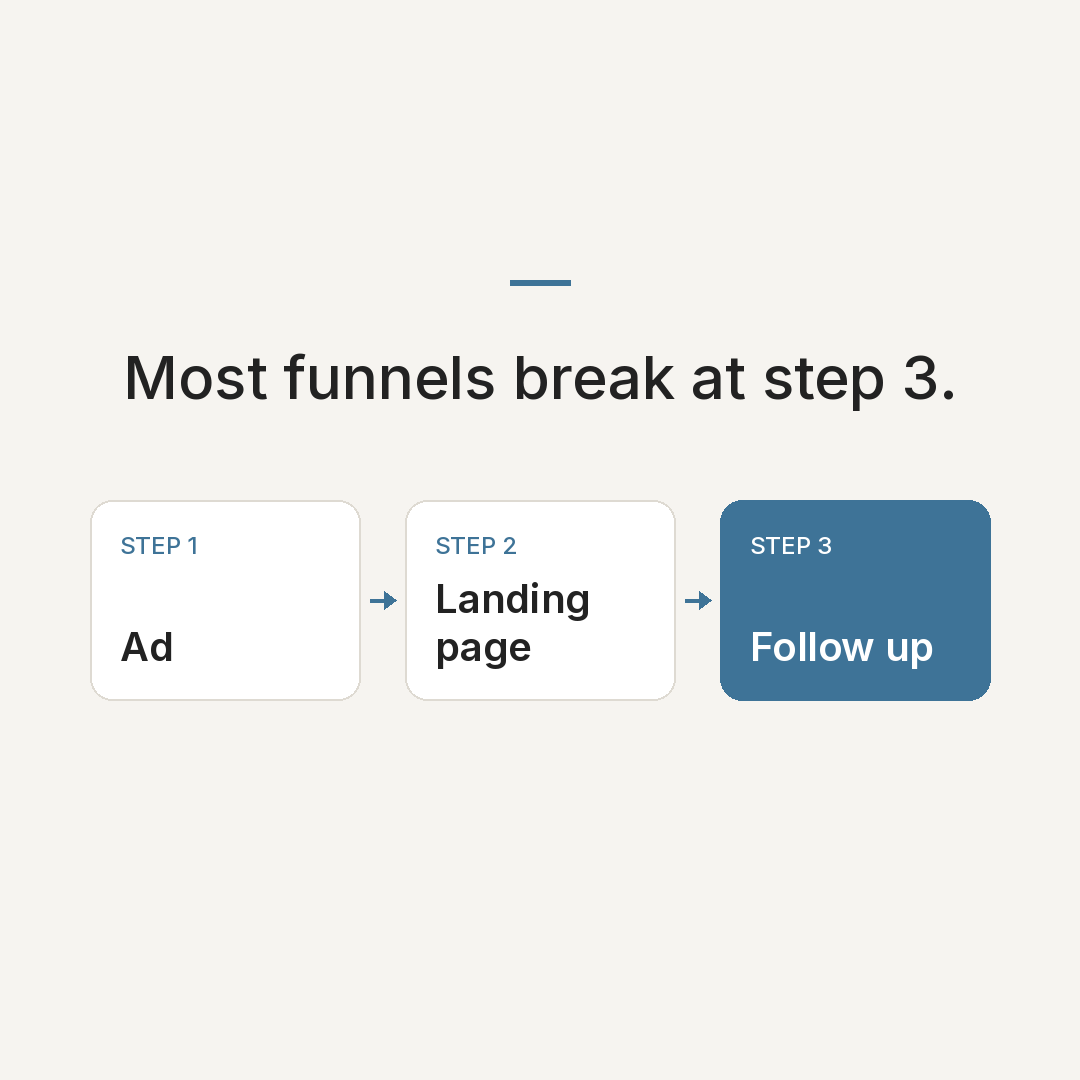
Why funnels break at step 3
Most funnels are built in the order people see them. First the ad. Then the landing page. Then, if there is time left, some kind of follow-up. That order makes sense when you are building, but it means the last step gets the least attention.
So the ad gets clicks. The landing page gets sign-ups. And then the new lead gets a single “thanks for signing up” email, or nothing at all. A few days later, they have forgotten why they signed up. The money and effort spent on the first two steps leaks out at the third.
A sign-up is not a sale or a booking. It is a small yes. Someone raised their hand for a moment. What happens in the next few days decides whether that small yes turns into anything.
The usual reasons follow-up gets skipped:
- It feels less exciting than ads and page design.
- The team plans to follow up by hand, then gets busy.
- Leads land in a spreadsheet or inbox instead of a CRM that can act on them.
- Nobody owns the step after sign-up.
The three-step funnel: Ad, Landing page, Follow-up
A simple funnel has three parts. Each one has one job.
- Ad: get the right person to click.
- Landing page: get them to sign up for one clear thing.
- Follow-up: turn that sign-up into the next action, like a booked call, a purchase or a reply.
The first two steps are about getting attention. The third is about using it. If you only fix one step this week, fix the follow-up, because it works on leads you have already paid for.
The fix: three automated messages after sign-up
You don't need a long nurture sequence to start. Three well-timed messages cover most of the gap. Set them up in your CRM or email tool so they trigger the moment someone signs up. Use email, and add SMS only where you have clear consent.
Message 1: Right away, deliver what they asked for
Send this within a minute of sign-up. Give them exactly what the landing page promised, and tell them the one next step. Speed matters here because they are still thinking about you.
Example wording: “Here's the [guide / checklist / link] you asked for: [link]. Most people start with page 2, it's the quickest win. If you have a question while you read it, just reply to this email.”
Message 2: Day 1 or 2, help them use it
Many people download something and never open it. This message makes it easier. Share one tip, one example, or one common mistake related to what they signed up for. Keep it useful on its own, even if they never open the original download.
Example wording: “Quick tip on [topic]: most people get stuck at [common point]. The simple fix is [one-line fix]. It's covered in more detail on page 4 of the guide.”
Message 3: Day 3 or 4, offer the next step
Now invite them to take the next action your business needs. It could be booking a call, starting a trial, buying, or simply replying with a question. Make it one clear option, and make it easy to say no.
Example wording: “If you'd like help applying this to your own situation, here's the next step: [link]. If now isn't the right time, no problem. You'll still get the occasional tip from me.”
After message 3, move anyone who hasn't acted into your regular newsletter or a slower nurture list, so they still hear from you without being pushed.
When someone takes the next step, stop the sequence for them. Nobody should get a “book a call” email after they've already booked.
How to build it
You can set this up in most CRMs or email tools, including GoHighLevel. The steps are the same everywhere.
- Send sign-ups straight into your CRM. Connect the landing page form so every new lead lands as a contact with a source tag.
- Create one workflow triggered by that form. Add the three messages with wait steps between them.
- Add a stop condition. If the lead books, buys or replies, remove them from the sequence.
- Alert a human on replies. Route replies to someone who will answer them the same day.
- Test it end to end. Sign up with your own email and check every message, link and timing.
Funnel follow-up checklist
- Form connects directly to the CRM, not a spreadsheet
- Each lead is tagged with its source
- Message 1 sends within a minute and delivers the promise
- Message 2 adds one useful tip
- Message 3 offers one clear next step
- The sequence stops when the lead converts or replies
- Replies reach a real person quickly
- All links tested on mobile
- Unsubscribe link present and working
- You review results every few weeks and adjust one message at a time
Common mistakes
- Only a thank-you email. One email with no next step is not follow-up.
- Waiting too long. A lead contacted days later has often moved on.
- Selling in message 1. Deliver what you promised first. Ask later.
- No stop rule. Sending booking reminders to people who already booked looks careless.
- Leads in the wrong place. If sign-ups sit in an inbox or spreadsheet, automation can't touch them.
- Changing everything at once. Adjust one message at a time so you know what made the difference.
FAQ
Where do most sales funnels break?
Very often after sign-up. The ad and landing page get the attention, but leads receive little or no follow-up, so interest fades before they take the next step.
How many follow-up messages should I send after someone signs up?
Three automated messages is a solid start: one right away to deliver what they asked for, one a day or two later to help them use it, and one a few days in to offer the next step.
How fast should the first follow-up go out?
Right away, ideally within a minute. The lead is still thinking about you, so this is when they're most likely to open and act.
Should follow-up be email or SMS?
Email works for most funnels. SMS can help for time-sensitive steps, but only use it where the person has clearly agreed to receive texts.
More on the Sheik Oli blog.